
Inspect the reporting standard before you commission a BESS review
This public specimen shows how Oxaide states a finding, bounds confidence, links telemetry to commercial consequence, and recommends the next move. It is illustrative by design and intentionally avoids live client evidence.
Illustrative sample report
BESS forensic report
Findings, evidence basis, risk posture, and next-step recommendation arranged the way a real investment or operating review would need them.
Cover finding
Usable capacity and stress signals no longer support the clean operating narrative.
Evidence insert
Dispatch guardrails excerpt
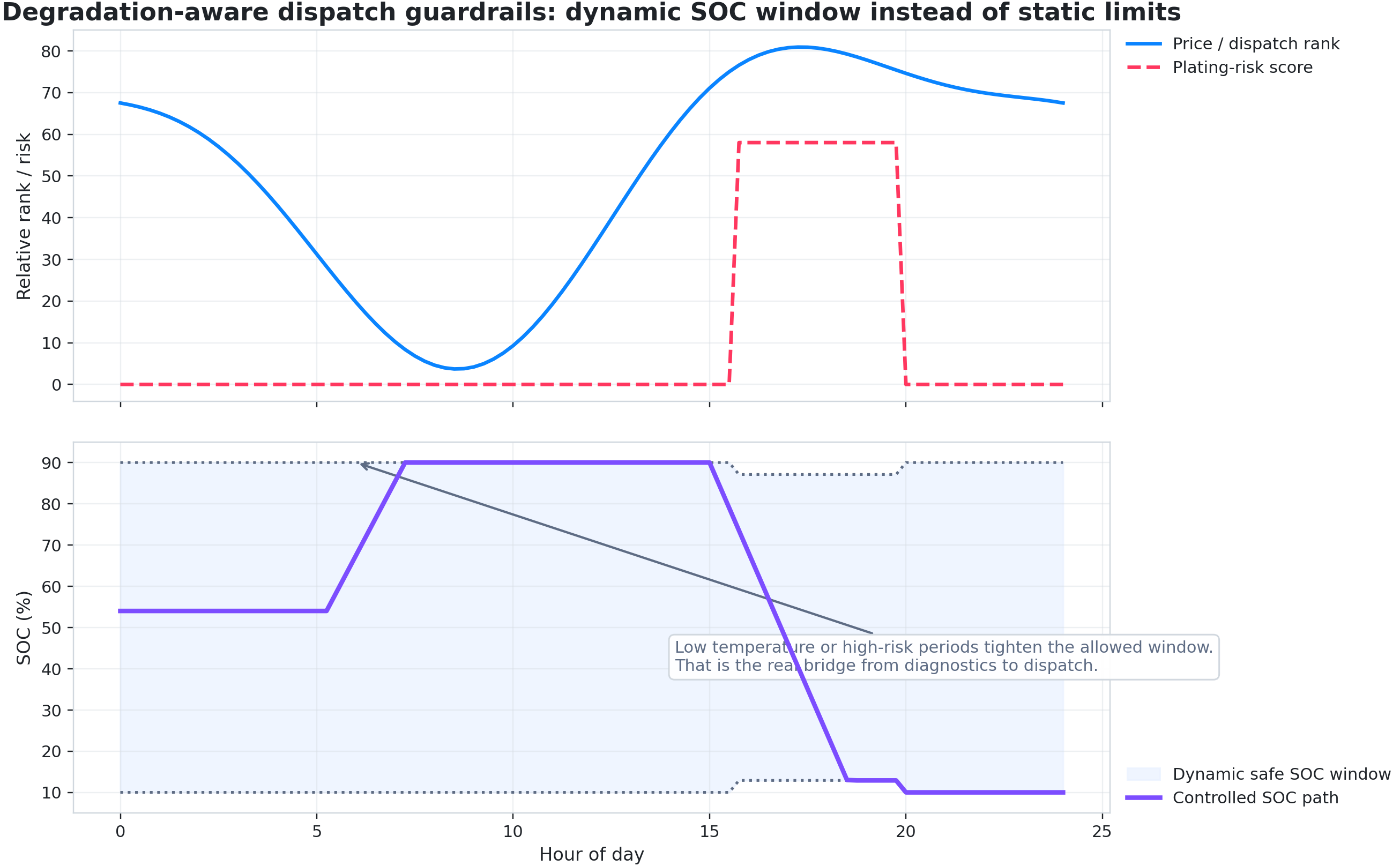
The preview stays uncropped so you can actually read it. Open the full chart if you want a closer look.
What you are inspecting
The reporting standard itself: executive finding, confidence posture, evidence chain, decision translation, and recommended next move.
Why teams review this first
Before sharing live telemetry, buyers, owners, lenders, and insurers want to know whether the eventual work product will be bounded, legible, and decision-grade.
What remains deliberately illustrative
No client file, no implied deployment proof, and no invented operating outcome. The sample is public to show reporting discipline, not borrowed credibility.
Illustrative report structure
What a decision-grade report needs to make legible
Oxaide reports are built to bridge raw telemetry and decision language. The point is not decorative science. It is a bounded finding, an explicit confidence posture, an evidence chain, and a next step people can use in a real decision room.
Executive finding
Usable capacity and stress signals no longer support the clean operating narrative.
The finding below is illustrative, but the structure is real: concise headline, confidence posture, evidence basis, and immediate decision consequence.
Evidence chain
- Weakest-link divergence identified before fleet-average comfort language.
- Resistance and transition behaviour consistent with stress accumulation.
- Usable-capacity reality weaker than top-line health labels imply.
Decision translation
- Supports tighter diligence reserve or downside language.
- Improves the quality of warranty or insurer positioning.
- Creates a cleaner basis for post-COD operating intervention.
Risk posture
Elevated but still actionable
Confidence posture
Sufficient for a scoped decision and next-step recommendation, with site-specific telemetry depth determining whether escalation is warranted.
Recommended next move
Narrow the question to the limiting block or operating window, preserve raw telemetry, and frame the next review around the actual decision at hand before narratives harden.
Demonstration boundary
This sample demonstrates format, discipline, and decision structure. It is not presented as live portfolio evidence and should be read as a demonstration of reporting quality, not client deployment proof.
Where this reporting standard matters most
Scope first
Defined review scope
Boundary, telemetry window, and mandate question are pinned down before conclusions move.
Encrypted handling
Protected review workflow
Review traffic and operating data are handled with encrypted transfer and controlled access.
Customer boundary
Customer-controlled deployment
Managed, private, and isolated deployment paths are available when the environment requires them.
Direct accountability
Principal sign-off
Technical accountability stays close to the method rather than disappearing into a generic workflow.