Oxaide
Claim boundary

BESS method validation: what is proven now, what is supported, and what is not yet claimed

The current public proof base is strongest in lithium-ion, especially LFP-first utility BESS positioning. The purpose of this page is simple: make the proof hierarchy behind the independent forensic layer visible without pretending it is broader than it is.

What makes this page useful

Validation should read like governance, not like a second atlas.

Disciplined proof language does not throw every chart back at the reader. It establishes what the public evidence does, where it stops, and what has to happen next before a live-asset conclusion is defensible.

That is the role of this page: to make the benchmark posture, claim boundary, and review handoff unmistakably clear.

Direct public anchors

Oxford derivative chemistry, NASA anomaly and resistance context, and the current telemetry-to-review translation path.

Strongest claim today

A coherent, benchmark-backed lithium-ion method stack, with strongest public support today in LFP-first utility BESS positioning.

Not claimed publicly

Not universal chemistry proof, not multi-vendor fleet proof, and not a shortcut around live telemetry, site history, and mandate-specific review.

Current public anchors

These are the benchmark references carrying the public method case today.

The public stack should be legible in a few disciplined anchors: derivative chemistry, anomaly and resistance context, corroboration when the flagship signal is fragile, and operating-context translation before commercial language is used.

REFERENCE DATASET
OxfordICA

dQ/dV peak-shift logic.

Peak shift

Oxford / ICA

Electrochemical signature anchor

The strongest public anchor for derivative-based degradation interpretation inside the current Oxaide method set.

Dataset

Oxford Battery Degradation Dataset

Evidence reference

Oxford ICA Peak Shift

Read Oxford study
ANOMALY PRECURSOR
NASAPrecursor

Resistance and precursor logic.

Precursor sequence

NASA / anomaly

Resistance and precursor detection

The benchmark layer that supports anomaly, resistance, and early-warning interpretation before site-specific telemetry enters the room.

Dataset

NASA PCoE Battery Dataset

Evidence reference

NASA Thermal Precursor

Read NASA study
CORROBORATION LAYER
OxfordDVA

Secondary electrochemical cross-check.

DVA

Oxford / DVA

Corroboration when ICA is fragile

DVA earns its place by supporting or challenging the flagship ICA interpretation when field telemetry is noisy or undersampled.

Dataset

Oxford Battery Degradation Dataset

Evidence reference

Oxford DVA Mechanism

Review ICA and DVA logic
RESISTANCE SEQUENCE
NASAResistance

Transition and stress logic.

Resistance logic

Cycle context

Dispatch and stress regime context

Before revenue or underwriting conclusions are drawn, the operating regime has to be read properly. This is the bridge from technical trend to asset-level decision language.

Dataset

NASA PCoE public benchmark context

Evidence reference

NASA Cycle Dispatch Context

Read operating context

Proof hierarchy

This is how the claim should be read.

01

Public benchmark logic

Oxford and NASA show that the diagnostic logic is real, reproducible, and worth taking seriously.

02

Disciplined claim boundary

Public evidence should support a narrow, defensible statement rather than a universal fleet-wide boast.

03

Live telemetry review

Asset condition is only established when operating history, site telemetry, and mandate-specific context are actually reviewed.

04

Commercial decision translation

Only then should the work move into diligence, warranty, refinancing, insurer, or post-COD decision language.

Representative figures

Use a few serious figures to support the claim, not an undisciplined chart dump.

Validation reads best when a small number of benchmark figures carry the argument cleanly and the full appendix is left to the atlas.

Oxford / ICA

Electrochemical signature anchor

The strongest public anchor for derivative-based degradation interpretation inside the current Oxaide method set.

Dataset anchor

Oxford Battery Degradation Dataset

Evidence reference

Oxford ICA Peak Shift
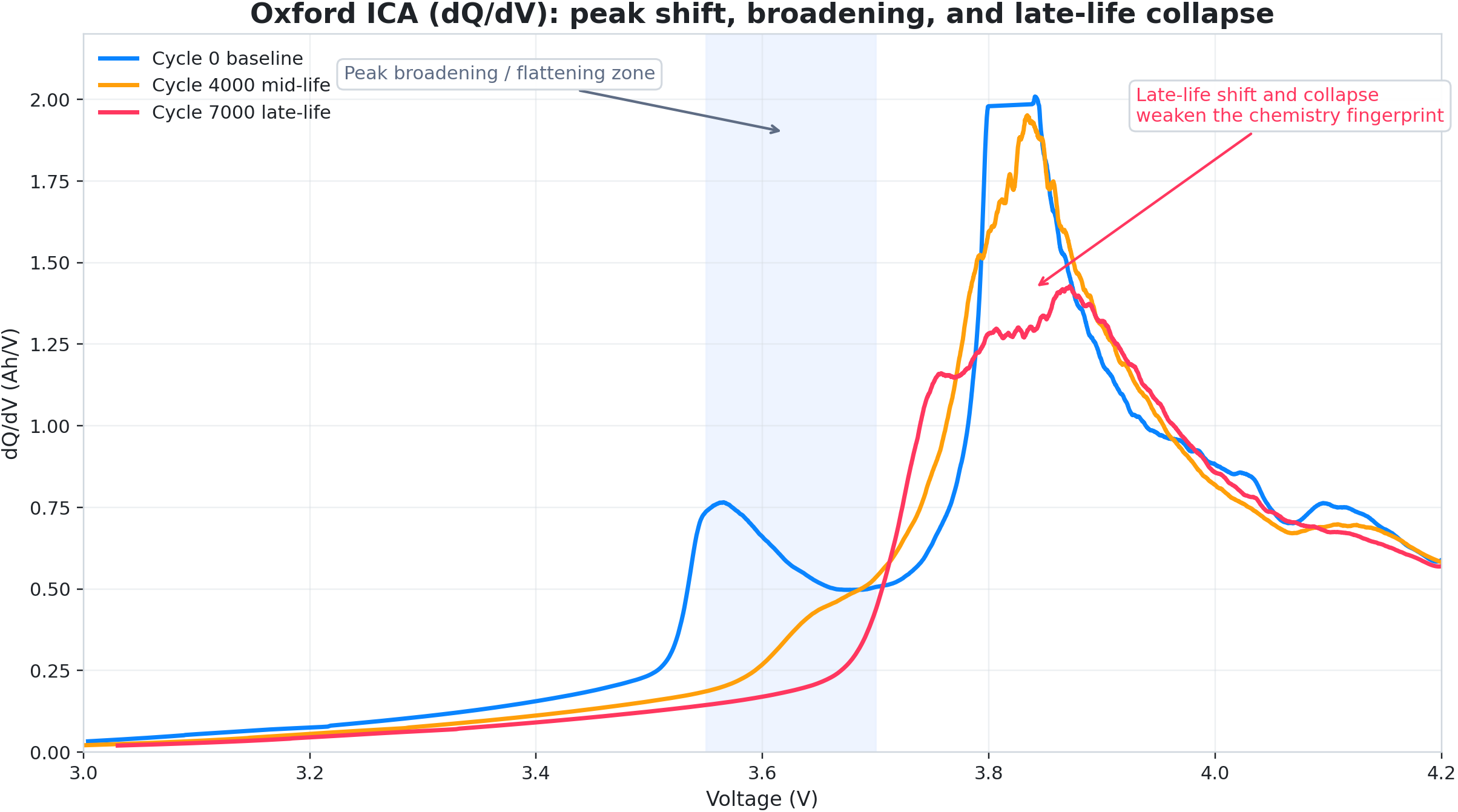
NASA / anomaly

Resistance and precursor detection

The benchmark layer that supports anomaly, resistance, and early-warning interpretation before site-specific telemetry enters the room.

Dataset anchor

NASA PCoE Battery Dataset

Evidence reference

NASA Thermal Precursor

Weakest-link

Operational drag before chemistry escalation

The public pack is strongest when it shows not only chemistry and anomaly logic, but the triage path serious operators actually use.

Dataset anchor

NASA PCoE Battery Dataset

Evidence reference

NASA Weakest Link Divergence

How to read this evidence base

This evidence base exists to support review work, not to replace it. Public datasets help show that the method logic is real. They do not replace site-specific diligence, warranty evidence, or post-COD review of a live operating asset.

That is why Oxaide positions validation studies as benchmark evidence and keeps the language disciplined. The goal is a precise claim, not a broad one.

Operating posture

Scope first

Defined review scope

Boundary, telemetry window, and mandate question are pinned down before conclusions move.

Encrypted handling

Protected review workflow

Review traffic and operating data are handled with encrypted transfer and controlled access.

Customer boundary

Customer-controlled deployment

Managed, private, and isolated deployment paths are available when the environment requires them.

Direct accountability

Principal sign-off

Technical accountability stays close to the method rather than disappearing into a generic workflow.